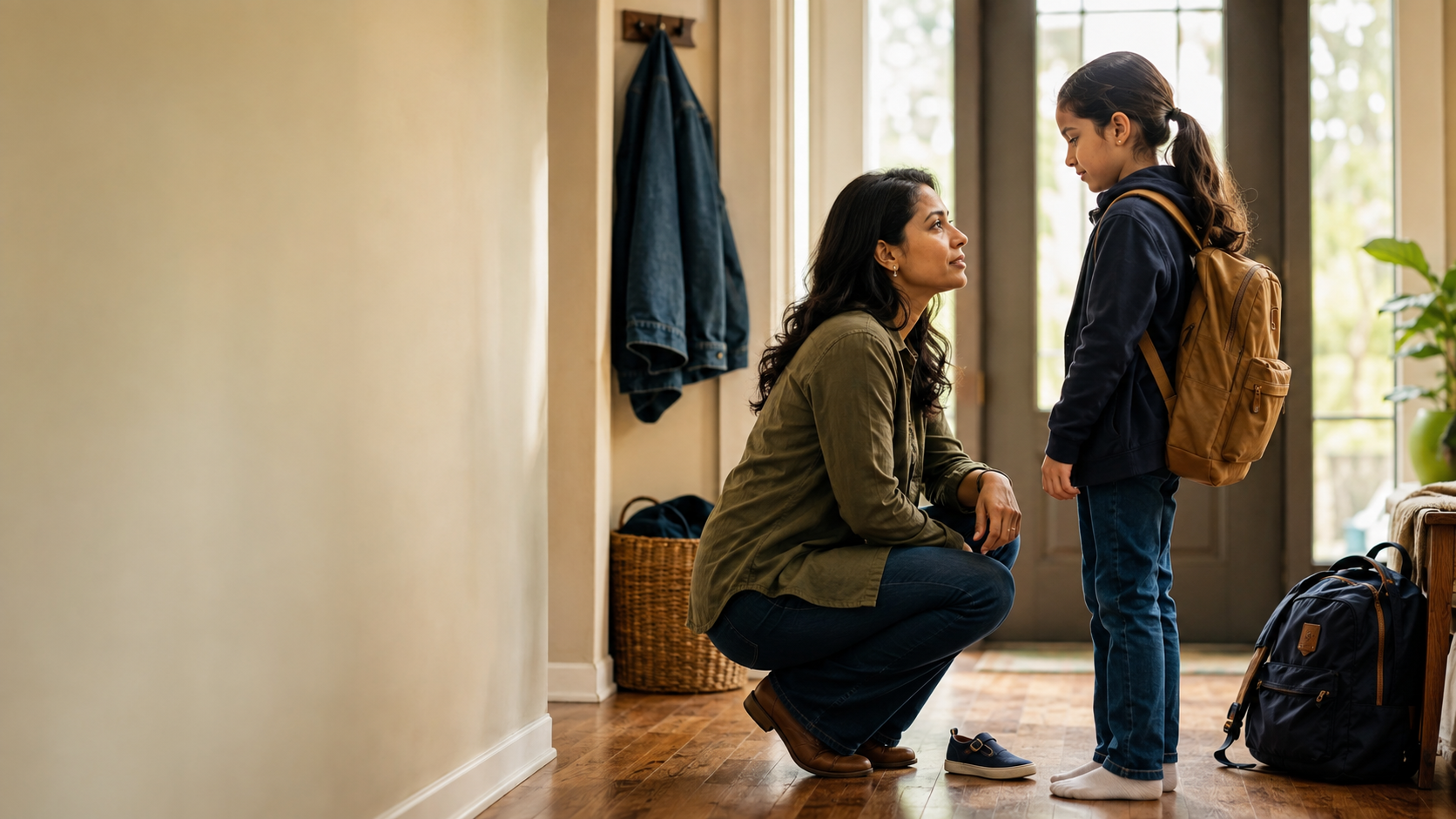
You know what you meant. What did your child hear?
Words Grow Worlds helps parents understand what children may be learning from everyday interactions and choose words that build capability, connection, responsibility, and self-trust.
Notice without shameHold boundaries with connectionReturn after a hard moment
capableheardbraveresponsibleloved
Real moments, not generic advice
Maybe it is not that you need more parenting information.
You need support inside the situations that keep happening.
01The rushed morning when you have already asked five times
02The child who falls apart after school
03The sibling fight that pulls you into yelling
04The boundary that becomes a power struggle
05The bedtime conversation you replay later
Practical help for what keeps happening
Know what you want to teach before the same situation happens again.
For one repeating situation, we help you understand what may be underneath it, decide what you want your child to learn, and prepare words for before, during, and after. We call that personalized guide a Moment Key.
It is not a script to memorize. It is a key you can return to when the moment happens again.
MOMENT KEY
“I can’t do it.”
What you are growing: Self-trust + problem-solving
UNDERSTAND THE MOMENT
Struggle may be starting to feel like proof that your child is not capable. The opening is to help them experience being stuck as a place to pause, ask for help, and try a next step.
IN THE MOMENT
“You’re stuck. Let’s figure out which part feels hardest.”
IF THEY WANT YOU TO TAKE OVER
“I’ll help, but I’m not going to take over. Which part should we solve together?”
RETURN LATER
“You got stuck, asked for help, and kept working until you figured it out.”
Useful in more than hard situations
Some guides help you through what feels hard. Others help you notice courage, honesty, growth, or connection you do not want to miss.
Hard moments
The morning rush, a sibling fight, screen-time ending, homework, or bedtime.
Inner moments
“I can’t.” “Nobody likes me.” “I’m scared.” “I hate myself.”
Growing moments
Telling the truth, trying again, asking for help, speaking up, or recovering.
Transition moments
A first day, a new sibling, moving, puberty, a first phone, or not making the team.
Connection moments
After school, car rides, dinner, bedtime, after conflict, or before a big day.
What we mean by a world
A child's world is what they are learning to expect about themselves, other people, relationships, and life from what they experience again and again.
Words help children interpret those experiences.
A believable transformation
The hard situations may still happen. But you can understand more of what is happening inside them, recognize the messages that may be repeating, have words ready, and know how to reconnect when things do not go the way you hoped.
You do not have to become a perfect parent to change what grows next.
Our mission
Help families see what's growing.
Words Grow Worlds helps parents understand what their children may be learning from everyday family life and use words more intentionally to grow the beliefs, skills, and ways of seeing themselves they want their children to carry forward.
We do not teach perfect communication. We help families notice the lessons already forming inside mistakes, limits, courage, conflict, accountability, repair, and beginning again.
How meaning can grow
The same rushed morning can teach more than how to put on shoes.
You may be trying to get everyone out the door. Your child may also be making meaning about struggle, responsibility, and who they are when things go wrong.
A familiar morning. A lesson neither of you planned.
WHAT IS HAPPENING
The shoes are still not on. Everyone is late.
You need the shoes on, everyone out the door, and your child to take responsibility for their part.
WHAT THE PARENT MAY SAY
“Why do you make every morning so difficult?”
WHAT YOU MEANT
We need to leave. I need you to take responsibility for getting ready.
WHAT YOUR CHILD MAY HEAR
I am the difficult part of this family. I make things harder.
WHAT CAN ENTER THE NEXT MORNING
The child may arrive already expecting frustration, criticism, or failure.
Not because one sentence predicts a child, but because repeated experiences can begin shaping what a child expects.
What happens
What is said
What the child may understand
What repeats
What they may come to expect
How they enter the next moment
This is a way to look, not a formula for predicting a child. Language is one influence among many, and there is always room to return.
The Words Grow Worlds Method™
Meaning comes before wording.
We do not begin with “What should I say?” We begin with “What do I want my child to learn here?” Then the words have a purpose.
Recognize the moment and what is happening inside both of you.
02Uncover
Look for the lesson or message that may be repeating underneath it.
03Choose
Name the belief, value, or message you want to strengthen.
04Speak
Use clear, truthful words that support what you chose.
05Return
Clarify, repair, or name what deserves another moment.
Two directions of noticing
We notice what may need changing and what is already growing.
What may need changing
“What message keeps showing up that I do not want my child growing with?”
What is already growing
“I saw courage. I saw honesty. I saw persistence. I saw my child recover.”
What you notice begins to grow.
What we stand for
No perfect-parent promises. No shame. No scripts that erase the boundary.
Words Grow Worlds helps parents understand a moment, choose what they want to grow, and find words that fit their family. We never make one difficult sentence the verdict on a child or parent.Read our promise to families →
Possibility, not diagnosis
We use may, might, and could. We never claim to know what a child believes from one report.
Accountability without shame
Connection does not remove limits, responsibility, or the truth of what happened.
No perfection standard
One difficult sentence does not define a child. Awareness, repetition, and return matter more than performing every moment perfectly.
Return is always available
A hard interaction does not have to become the final story. Families can clarify, repair, listen, and begin again.
Begin here
Notice what happened. Uncover what may be getting learned. Choose what you want to grow next.